<Escaping human-ceterism and binary-thinking: springtails, Experimental Animals Memorial and cicadas>
Talk : 2023 Invitation to Korea Season Cultural Exchange to Celebrate 140 Years of Diplomatic Relations between Korea and the UK
CREAM: Centre for Research and Education in Art and Media_ (CREAM), University of Westminster, London
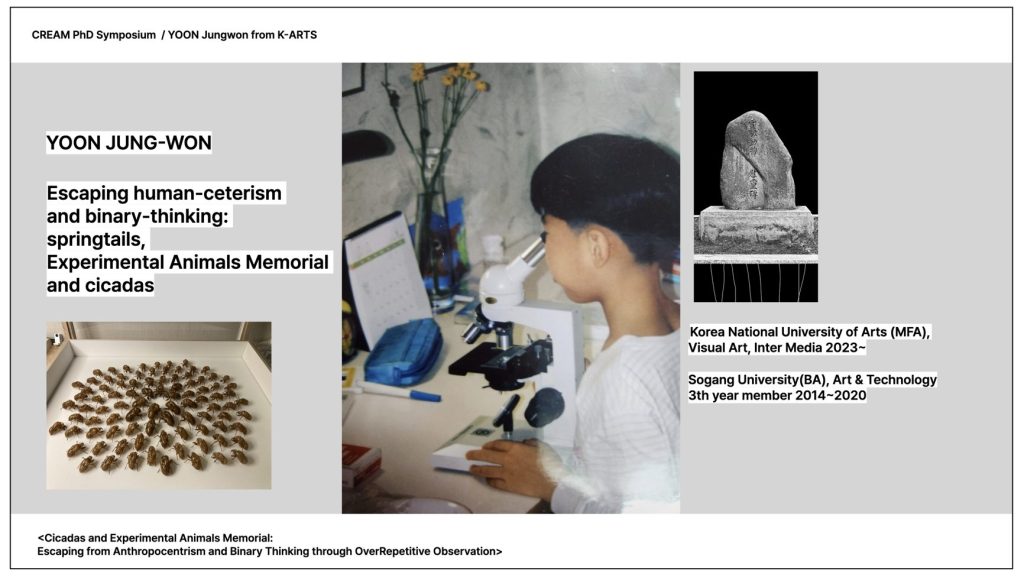
만나서 반갑습니다. 저를 이 자리에 초대해주셔서 감사합니다.
저는 오늘 저의 리서치 주제가 어떻게, 왜 바뀌어왔는지 공유하고자 합니다. 이는 관점의 변화에 대한 이야기이기도 합니다. 어떻게 제가 비바리움과 관찰기계로부터, 실험동물 위령비, 매미의 허물을 바라보게 되었는가 하는 이야기 입니다.
It’s a pleasure to meet you, and thank you for inviting me to be here.
Today I’d like to share how and why my research interests have changed.
It’s also a story of a shift in perspective: how I went from looking at vivariums and observation machines to Experimental Animals Memorials and shell of Cicadas.
가공컨테이너와 비바리움에 대하여 (2019 ~ )
어린 지설 저는 생태학자가 되고 싶었습니다. 지표면 아래는 무엇이 있을까? 죽음이란 무엇인가? 뿌리는 어디까지 뻗어 있는 걸까? 나무 줄기에 귀를 대면 들리는 물소리는 무슨 힘으로 흐르고 있는걸까? 개미는 어떻게 사고할까? 궁금증은 궁금증을 낳았습니다. 순수한 호기심으로 생태학의 영역을 공부 하였습니다.
과학선생님이었던 큰아버지에게 학교에서 폐기한 현미경 하나를 선물받았습니다. 주차장에서 자동차 서치라이트를 켜고 사용법을 알려줬습니다. 그렇게 미시세계를 만나게 되었죠. 눈을 떠서 잠드는 순간까지 감각하기를 멈추기 않았습니다. 눈을 뜨며 망막에 맺히는 상을 느꼈고, 그 빛이 어떻게 시신경 세포의 작용에 의해 전기 신호로 바뀌고, 일부는 통증으로 전달되는지 느꼈습니다. 그 전기 신호가 어떻게 화합물들의 이동이 되는지 느꼈습니다. 저는 매일 공생의 느낌을 감각하며 사는 일에 완전히 매료 되었습니다.
About Containers and Vibariums (2019 ~ )
When I was a kid, I wanted to be an ecologist.
What’s beneath the surface?
What is death?
What is the force behind the sound of water- when you put your ear to a tree trunk? Curiosity begets curiosity, and I studied the field of ecology out of pure curiosity.
My uncle, who was a science teacher, gave me a microscope that had been discarded by the school. He turned on the car searchlights in the parking lot and showed me how to use it. That’s how I was introduced to the microscopic world. I didn’t stop sensing until the moment I opened my eyes and fell asleep. I felt the image on my retina as I opened my eyes; I felt how that light was turned into electrical signals by the action of optic nerve cells, some of which were transmitted as pain; I felt how those electrical signals became the movement of compounds; and I became completely fascinated with living with the sensation of symbiosis every day.
그런데 그 이후 교육기관에서 공부했던 과학은 저를 또 다른 곳으로 데려갔던 것 같습니다. 어떻게 쥐의 배를 가르고 맹장을 분리해 다시 봉합할 수 있는지도 알게 되었고, 어떤 공부를 해 연구를 하면 돈을 많이 벌 수 있는지도 알게 되었습니다. 폐쇄된 비바리움 안에 작은 생태계를 만들고 소유할 수 있는 방법도 알게 되었습니다. 자본주의 사회 시스템 안에서 훌륭히 기능하도록 하는 한국 교육, 심지어 나를 훌륭한 학생의 표본으로 삼기 위해 적용된 한국의 엘리트 교육은, 공생의 감각들로부터 나를 완전히 격리 시켰습니다. 교육만은 아니었습니다. 온종일 마주치는 모든 이미지와 듣는 노래, 먹는 음식과 지인과의 대화들이 나를 수퍼 자본주의자로 만들었습니다. 더이상 공생의 감각이 느껴지지 않았습니다. 그래서 나는 나를 다른 종들로부터 분리시키는 이 힘의 작용이 어디서 온 것이고, 어떻게 발명 된 것이며, 어떻게 작동하고 있는지 리서치 하기 시작했습니다.
But the science I studied at the institution after that took me to another place: I learned how to cut open a rat’s stomach, separate its appendix and sew it back together, and I learned how to make a money doing research.
I also learned how I could create and own a small ecosystem inside a closed vivarium.
My Korean education, especially the elite Korean education – that was applied to – make me function well – within the capitalist social system, to make me an example of a good student, completely isolated me from any sense of togetherness. It wasn’t just education.
Every image I encountered throughout the day, every song I listened to, the food I ate, and the conversations I had with my frend turned me into a super-capitalist. I no longer felt a sense of togetherness.
So I started researching : where this force separating me from other species came from, how it was invented, and how it works.
리서치 과정에서, 이 힘을 가지는 구조는 어디에나 들이댈 수 있는 매끈하고 부드럽고 깜찍한 변질-머신으로 작동하고 있음을 목격했습니다. 이 인간중심주의적 관점이 구조가 되었을 때 더 강력한 힘을 가지게 됩니다. 미디어가 충분히 고도화되고 나면, 그것이 비추고 있던 실제 생명체가 더 이상 존재하지 않거나 완전히 다른 것이 되어도 알 수 없게 됩니다. 그리고 이렇게 충분히 실험하고 연습해 고도화된 미디어의 랜더링 대상은 인간도 예외가 아닙니다.
In the course of my research, I observed that the structure that holds this power operates as a sleek, smooth, cuddly metamorphosis-machine or rendering-machine that can be plugged in anywhere.
When this Human-centered perspective becomes a structure, it becomes even more powerful. Once the media is sufficiently sophisticated, it is impossible to tell – when the real life – it was reflecting – no longer exists or has become something else entirely.
And humans can also be subject to the structure
대상이 사라져도 기계는 남는가
If the object disappears, does the machine remain?
이를 실험 해본 영상이 <톡토기 인형극> 작업입니다. 다양한 기계에서 카메라가 움직이는 방식, 제물대가 설치되는 방식을 모았습니다. 그리고 이것을 제가 만든 조형물을 통과시키는 기계로 사용합니다. 이때의 리서치는 확연한 이분법적 틀 안에서 어떻게 그 중간지대를 다른 방식으로 만들어 볼 것인가 고민하는 과정이었습니다. 이 기계 안에 들어있는 것은 ‘현미경으로 보는 행위’에 대한 작가의 생각으로만 만들어낸 유기체 형상의 스티로폼입니다. 이 형상을 통과시켜 나온 이미지는 유기체 없는 유기체의 이미지 입니다.
This is a video how I experimented,
and it’s called “Toktogi Puppet Theater”. It’s a collection of different machines, – the way the camera moves, – the way the observation table is set up. I use it as a machine to pass my sculptures through.
The research at this time was a process of thinking about how to create the in-between in a different way within a binary framework. What is inside this machine is in the shape of an organism, created solely by the my idea of the act of looking under a microscope. The image that comes out of passing this shape is an image of an organism without an organism.
질문: 인간중심주의와 이분법을 기존의 기술로 해체할 수 있을까.
질문: 나를 다른 종들로부터 분리시키는 힘은 어떻게 적용되고 있는가.
질문: 대안의 공간을 만들어 낼 수 있을까.
Can human-ceterism and binary-thinking be dismantled with existing technologies?
How are the forces that separate me from other species being applied?
Can we create alternative spaces?
다음과 같은 기계도 만들었습니다. 한쪽의 컨테이너에 오랜시간 반려해온 톡토기의 사육 장치를 두고, 이들을 촬영해 실시간으로 행동을 추적할 수 있도록 했습니다. 원시적인 형태의 비인간-모션-트래커라고 상상해볼 수 있겠습니다. 컴퓨터 안에서 프로그램은 어떤 가상의 지대를 만들고 있습니다. 이 가상의 땅을 중간 지대라고 상정하겠습니다. 관객은 VR 헤드마운트를 쓰고 이 지대에 접속 할 수 있습니다. 이 기기를 썼을 때 관객이 보는 것은, 수많은 인간-인형이 기어다니는 무대입니다. 곧 관객은 이 프로토타입 무대 위에 있는 인간 인형들 중 하나의 시점으로 보고 있음을 꺠닫게 됩니다. 또, 다른 인간 형상들이 접속한 다른 톡토기들임을 알게 됩니다. 비인간 생물종을 준-인간화하여 끌어오거나, 전혀 접속 할 수 없는 존재로 신격화 하는 대신, 그 중간의 이상한 감각이 느껴지는 언-캐니한 상황을 만들어보고자 한 것입니다. 이 감각이 이상하게 느껴지는 것 자체가 모순을 그대로 드러냅니다. 인간의 형상일 때, 그리고 그들 중 하나의 시점으로 볼 때 감각되는 현존감은, 박스안에 들어있는 그들을 보거나, 데이터를 볼 때 와는 전혀 다른 것입니다. 한번 이런 경험을 하고나면, 다시는 이 2mm의 개체군이 그전과 동일하게 보이지 않습니다. 이런 단순한 그래픽으로도 실험해 볼 수 있었습니다. 인간중심주의적 관점으로 만들어진 기술을 만들어진 목적과 다르게 쓰는 일은 분명 필요한 실험이었습니다.
I also built a machine that looks like this In a container on one side, – I have a breeding unit of soil organisms that I’ve had for a long time, and I’ve filmed them in realtime so that I can track their behavior.
You can imagine it as a primitive form of non-human-motion-tracker.
Inside the computer, the program is creating some kind of virtual land.
Let’s call it – the middle ground, and the audience can access it by putting on a VR HMD. What they see when they put it on is a stage with a bunch of puppets crawling around.
Soon, they realize that they’re seeing it from the perspective of one of the puppets on this prototype stage. They also realize that the other puppets are other soil organisms that they’ve connected to.
Instead of dragging in non-human species by semi-humanizing them, or deifying them as inaccessible, I wanted to create an uncanny situation where there is a strange sense of something in between, – and the very fact that it feels strange reveals the contradiction.
The sense of presence – you get when you see them in human form, – and from the perspective of one of them, is completely different than when you see them in a box, or when you see them as data. – Once you’ve experienced this, you’ll never look at that 2mm individual in the same way again.
Even with a simple graphic like this.
it was a necessary experiment: using technology created from an human-centered perspective for a different purpose than the one it was created for.
이 작업은 2019년 부터 2022년까지 천천히 디벨롭해 왔습니다. 마지막 사진은 점균류(슬라임몰드)를 직접 배양하고 이를 반영한 중간지대에서의 퍼포먼스와 설치물의 사진입니다.
This work has been developing from 20 19 to 20 22. The last photo is of the performance and installation of the work, I cultured my own slime mold and incorporated its life cycle into the work.
비바리움을 만들고 토양생물들을 반려하는 일은 앞선 이야기들이 끊임없이 중첩되게 합니다. 이를테면, 내가 반려하고 있는 도마뱀은 뉴칼레도니아에서 온 것입니다. 그들은 유전적으로 한국 서울에서 최종 개량되었습니다. 이런 모양의 수많은 박스에 사육되고 있습니다. 이런 멸균박스를 떠올리게 하는 케이지는 실험실 환경에서 온 것입니다. 이들을 처음 밀렵한 것은 1993년 독일의 밀렵꾼 Robert Seipp이었습니다. 수년 째 반려하고 있는 공벌레와 쥐며느리도 마찬가지로 유럽에서 온 종입니다. 학명과 그 종에 대한 언어적 정의는 유럽에서 완성된 것입니다. 하지만 이미 이들은 유럽에서 정의된 종과 완전히 다른 무언가가 되었습니다. 이들을 반려하는 방식, 취미로 다루는 방식은 중국에서 만들어지고 한국을 거쳐 일본에서 완성된 것입니다. 그들은 오랜 역사 동안 생물종을 작은 비바리움에 넣고, 이 안의 식물과 작은 나무들을 고도로 발달된 방식으로 통제하는 방법을 개발해왔습니다. 하나의 풍경을 만들고자 하는 미적 수련의 일환이기도 합니다. 이들이 수십 세대를 거쳐 내 방에 함께 살고 있습니다. 나는 이들의 이미지를 수집합니다. 나의 할머니는 일본 오사카에서 태어나고 죽은 간호사 입니다. 이런 존재의 복합성이 이 다음의 리서치로 나를 이끌었습니다. 지금 진행중인 리서치 두개를 짧게 소개하겠습니다.
Creating vivariums and housing soil organisms is a constant overlap of stories. For example, the lizards I’m housing – are from New Caledonia. They were genetically finalized in Seoul, South Korea. They are housed in a number of boxes. The cages that look like sterilized boxes came from laboratory settings. They were first poached in 1993 by a German poacher named Robert Seipp.
The isopods that I’ve been keeping for years and years are also from Europe.
The scientific name and the linguistic definition of the species is something that was finalized in Europe,
but they’ve already become something completely different from the species as defined in Europe. The way they’re kept, the way they’re handled as a hobby is something that was created in China,
moved through Korea, and finalized in Japan. They have a long history of putting species into little vivariums and developing highly developed ways of controlling the plants and small trees in them. It’s part of an aesthetic practice of trying to create a landscape. They live in my room with me for generations. I collect images of them.
My grandmother was a Japanese nurse who was born and died in Osaka, Japan. The complexity of this existence has led me to the following research. I will briefly introduce two of my current research projects.
<식민지화와 자본주의, 영적인 믿음이 만나는 자리로서의 물질>
Matter as the site where colonization, capitalism, and spiritual beliefs meet
동물위령비에 대하여 (2021 ~ )
About Experimental Animal Memorials (2021 ~ )
저는 한국의 한국생명공학연구원(KRBB, Korea Research Institute of Bioscience & Biotechnology)의 과학자들과 협력해 왔습니다. 그들과 대화를 나누던 중에 한국생명공학연구원의 부지 내에
실험동물위령비라는 비석이 있다는 사실을 알게 되었습니다.
한국은 역사적 지리적 맥락에서 끊임없이 미국과 유럽의 백인 중심적 관점, 중국의 원본으로서 중심을 차지하려는 관성, 일본의 과거 식민지배적 실천과 수집-기록 사이에서 미끄러지고, 중첩되어온 곳입니다. 무언가 퇴적될 새도 없이 소용돌이 치고 뒤섞이는 물살이 있는 곳입니다. 그런 이유로 화학적 반응도, 물리적 뒤섞임도 자주 일어납니다. 동물 위령비는 그런 역사의 교차점에 놓인 물질입니다. 물리적인, 화학적인 화합물이라고 할 수 있습니다. 많은 사람들이 이 물질과 관련 의식을 당연하게 받아들이고 있고, 이상한 감각을 가지고 있지 않다는 사실도 놀랍습니다. 내가 이 주제에 매료되게 하는 요소 중 하나입니다.
비석의 형태와 실루엣은 각 기관의 관계자가 정하는 대로 제각각입니다. 위령 의식은 한국에서 명절에 주로 이루어지는 제의식과 유사하게 진행되는데, 밥상을 대신하는 책상을 두고, 그 위에 한국적 제의식의 규칙에 맞는 배치로 음식들을 올려놓습니다. 이때 이 음식들은 기니피그의 사료, 렛트 익스트루젼, 실험용 개와 고양이의 사료, 영장류 연구소의 원숭이들을 위한 바나나로 대체됩니다. 한국에는 대략 40개 정도의 기관 소속의 <동물 위령비>가 존재합니다. 한국 땅에 세워진 최초의 <동물 위령비>는 일제 강점기의 일본 의사들이 세운 것입니다. 그 너머에 있는 관점도 함께 세워졌습니다.
I’ve been working with scientists at the Korea Research Institute of Bioscience & Biotechnology (KRBB) in South Korea. During a conversation with them, I learned that there is a monument on the grounds of the KRBB called the
Experimental Animal Memorials.
Korea is a place that, in its historical and geographical context, has constantly slipped, slid, and overlapped between the white-centered perspectives of the United States and Europe, China’s inertia to take center stage as the original, and Japan’s past colonial practices of collecting and recording.
It’s a place of swirling and shuffling waters, where nothing is ever really deposited,
so there are frequent chemical reactions and physical mix-ups.
laboratory animal memorial, are substances that sit at the intersection of these histories. It’s a physical and chemical compound. It’s amazing how many people take this material and the rituals associated with it for granted – and don’t have any weird sensations about it. It’s one of the things that fascinates me about this subject.
The form and silhouette of the memorial stones are unique, as determined by each institution’s officials.
The memorialization ceremony is similar to the rituals that take place important days in Korea, with a desk replacing the traditional dining table, and food placed on it in an arrangement that conforms to the rules of Korean rituals – food for guinea pigs, food for laboratory dogs and cats, and bananas for monkeys at the Primate Research Institute.
In South Korea, there are about 40 Experimental Animal Memorials belonging to different organizations. The first memorials built on Korean soil were erected by Japanese doctors during the Japanese occupation of Korea. Beyond that, perspectives were also built.
나는 전국의 그 비석들을 찾아다니고, 그 맥락을 수집합니다.
이 사진들은 1967년, 1993년, 2013년의 부산 암남동의 항공사진입니다. 이 사진은 1926년에 촬영된 조선총독부혈청소의 사진입니다.
I search for them all over the country and collect their context.
These are aerial photos of Amnam-dong, Busan from 1967, 1993, and 2013.
This is The First Chronology of Serum Production for Curing Cattle Plague in Busan, photographed in 1926.
It was built by the Japanese Colonial Government of Korea.
혈청소는 다음과 같은 역할을 했습니다. 일본은 많은 자원을 약탈해 갔는데, 그 중 소도 있었습니다. 혈청소의 역사는 100년이 넘습니다. 일제는 1909년 이곳에 ‘수출우역검역소’를 설치했습니다. 2년 뒤인 1911년엔 ‘우역혈청제조소’를 창설했습니다. 당시 한반도에는 소에 치명적 바이러스 질환인 우역(牛疫)이 창궐했습니다. 일제는 일본으로 수출되는 모든 한우에 대해 검역 절차를 거치도록 하고 우역면역혈청을 제조하기 위해 위 두 기관을 설립했습니다. 한국의 현대 수의학의 출발점이자, 방대한 양의 동물실험의 시작이기도 했습니다.
이것은 일본이 일본 내부에 배포한 조선 소 판매 광고입니다. 조선의 소는 하루에 300평의 밭을 갈 수 있고, 200 관적의 짐수레를 끌고, 비료와 송아지를 생산하며, 산 가격보다 비싼 고기로 팔 수 있다는 내용입니다.
The serum station did the following:
Japan was plundering many resources, including cattle. The history of the serum station is more than 100 years old. In 1909, the Japanese established the Quarantine Station here. Two years later, in 1911, it established the “Cowpox Serum Manufacturing Plant.” At the time, the Korean Peninsula was experiencing an – outbreak of cowpox, a deadly viral disease in cattle.
The Japanese established these two organizations to ensure that all cattle exported to Japan went through quarantine procedures and to manufacture cowpox immunization serum. It was the beginning of modern veterinary medicine in Korea, and also the beginning of a massive amount of animal testing in korea.
This is an advertisement for the sale of Korean cattle distributed by the Japanese inside Japan. It claims that a Korean cow can plow 300 units of field per day, pull 200 units of carts, produce fertilizer, and sell meat – that costs more than the price of living.
이후 동물실험을 하는 장소마다 비석이 세워졌습니다. 나는 이 장소들을 하나씩 모두 방문하고 있습니다. 방문하기만 하는 것이 아니라, 그 주변의 이야기들을 함께 모으고 물질에 대해 사유하고 있습니다. 어떤 곳은 교육에 대해, 어떤 곳은 자본주의에 대해 생각하게 합니다.
Since then, a monument has been erected at each of these animal testing sites.
I am visiting all of these places by places.
I’m not just visiting them, I’m piecing together the stories around them and thinking about the material. Some places make me think about education, some places make me think about capitalism.
시간을 넘어서는 항해를 상상해 보겠습니다.
Imagine a sailing beyond time.
혈청소터 근처에는 붉은 색이 많습니다. 내가 이번 여름에 촬영한 부산의 혈청소터의 절벽 사진입니다. 혈청소가 있던 자리가 붉은 바위로 되어있습니다. 이는 암석에 철분이 많이 포함 되어있기 때문입니다. 하지만 이 장소의 역사에 대해서 알고 있는 저는 이것을 ‘선지’로 감각했습니다. 선지는 소의 피 덩어리로 만든 한국의 음식입니다. 젊은 사람들에게는 인기가 많지 않지만, 여전히 한국의 중요한 전통음식중 하나입니다. 이 장소의 돌을 하나 가져왔습니다. 선지를 반으로 쪼개면 이 돌과 같은 단면을 보여줍니다. 선지가 붉은 이유도 피 안에 들어있는 철분 때문입니다. 그 비릿한 냄새와 신체성도 함께 공유하고 있습니다. 저는 물질을 매개로 중첩되는 세계를 포착하고 있습니다.
그리고 미래의 동물위령비에 대해서 상상합니다. 미래의 동물 위령비는, 시공간 중첩의 현장으로서 물질을 재인식함으로서 드러날 것입니다.
There’s a lot of red around the serum site.
This is a photo I took this summer of the cliffs at the serum site in Busan. You can see the red rocks where the serum site used to be. This is because the rock contains a lot of iron,- but knowing the history of this place, I sensed it as ‘seonji’. Seonji is a Korean food made with chunks of cow’s blood.
It’s not very popular among young people, but it’s still one of the traditional foods in Korea.
I brought a stone from this place,
and when you break it in half, it shows a cross-section like this stone.
The reason why seonji is red is because of the iron in its blood.
It also shares its fishy scent and physicality. I’m capturing a world of overlapping materiality.
And I imagine a future animal memorial. The animal memorials of the future will be revealed through a re-awareness of matter as a site of space-time entanglement.
매미 허물에 대하여 (2023 ~ )
앞선 리서치와 작업들을 진행하면서, 과연 내 머릿속의 이분법적 사고의 습관을 지워낼 수 있을까 회의감이 들었습니다. 역사적 교차로에 놓인 잡종의 물질로서 동물위령비를 바라보는 대신에, ‘악한’ 동물 실험과 ‘선한’ 도덕적 양심의 결과물로 비석을 바라보게 되는 관성에 대해 의문을 가지게 되었습니다. ‘비인간’에 대해 이야기하면 할 수록 ‘인간’을 다시 중심에 두게 되는 경향을 발견했습니다. 앞선 저의 작업에서 그런 모순점을 생각하게 되었습니다. 이 지점에서 나는 모든 것을 내려두고 다시 어린아이의 눈으로 돌아가자고 생각했습니다. 그렇다 해도, 정말 어린아이의 눈으로 돌아가는 것도, 돌아갈 수도 없겠지요. 세상을 구조화하여 보는 방법을 배우고는 다시 언러닝 하는 것을 반복하기로 한 겁니다. 내가 이런 연습을 하기 위해서 무엇을 바라봐야 할까요. 20년에서 21년까지 관찰한 생물은 ‘톡토기’였고, 23년 여름에 내가 선택한 것은 ‘매미 허물’이었습니다.
사유의 대상을 선택하는데는 나만의 세가지 조건이 있었습니다. 첫번째, 과학자들에게도, 일반인들에게도, 비교적 낮은 인지도를 가지고 있을 것. 두번째, 그것이 자본주의 시스템 안에서 큰 가치를 평가받지 않는 사물이나 생물일 것. 즉, 자본주의 시스템에 포획시키는 그물이 너무 두텁지 않을 것. 세번째, 나를 매혹시키는 이야기일것. 내 생각을 연약하게 만드는 지점을 가지고 있을 것. 이런 물질을 선택함으로서 나는 고양이나 자동차를 생각할 때와 다른 방식으로 생각할 힘을 얻을 수 있습니다. 머릿속에 주입된 틀과 이미지로 자동적으로 납치당하지 않을 수 있기때문입니다. 훨씬 더 자유롭게 사고할 수 있습니다. 이들은 나에게, 아직 포획되지 않은, 탈주의 가능성이 충분히 남아있는 중개자들입니다. 나는 이들을 예술의 언어나 과학의 언어를 재현해 포획하는 대신에, 중간 산물을 잠시 내 방에 축적 하고 다시 돌려 보내는 방식으로 다루려고 합니다. 이 과정에서 집착적 관찰이 긴 시간 중첩되면, 몇 년의 길이로 늘어진 애니메이션과 같아집니다. 이 애니메이션의 프레임과 프레임, 관찰과 관찰 사이에서 발생하는 움직임과 그 유령은 인간중심주의 와 이분법적 세계관으로부터 탈주할 수 있는 이미지가 됩니다. 이 이미지들은 결국 탈주의 가능성에 대한 심령 사진, 심령 영화과 같은 증거들이 됩니다. 이런 증거들을 수집하는 것이 나의 작가로서 제 1의 목표입니다. 이런 재설정된 목표를 가지고 제가 전에 했던 예술작업을 다시 되돌아볼 생각입니다.
On the cast-off shell of Cicada (2023~)
In the course of my previous research and work, I became skeptical that I would ever be able to erase the habit of binary thinking from my mind. – Instead of looking at animal memorials as hybrid materials at a historical crossroads, – I questioned the inertia of seeing them as the result of “evil” animal experimentation and “good” moral conscience.
I noticed that the more I talked about “non-humans,” the more I tended to put “humans” back at the center. I was reminded of this contradiction in my previous work.
At this point, I thought, let’s drop everything and go back to a child’s eye, but then again, I don’t think I’ll ever really go back to a child’s eye. – I’m going to learn how to see the world in a structured way, and then unlearn it again.
What should I observe in order to practice this?
The subject of my observations from 20 20 was the springtail, and the one I chose in the summer of 2023 was the cast-off shell of Cicada.
I had three conditions for choosing an object of reflection:
first, it had to be ‘relatively’ unpopular with scientists and the general public.
Second, it had to be an object or organism that is not highly valued within the capitalist system, which means that the nets that trap it are not too thick.
Third, it has to be a story that fascinates me. It must have a point of vulnerability in my thinking.
By choosing these materials, I can empower myself to think differently than I would if I were thinking about a cat or a dog. I can think much more freely, – because I’m not automatically hijacked by the frames and images that have been implanted in my head. – These are, for me, intermediaries that have not yet been captured, – that still have enough potential for escape.
Instead of capturing them by reproducing the language of art or the language of science, – I try to deal with them by accumulating the intermediates in my room – for a while and sending them back out again. – In this process, obsessive observation, when superimposed over a long period of time, – becomes like an animation stretched to a length of several years. The movement between frame and frame, observation and observation, and the ghosts of these animations become images that can escape from human centered and binary thinking about the world. These images eventually become evidence, like psychic 프사이킥 photographs, psychic movies, – of the possibility of escape. Collecting such evidence is my primary goal as an artist. With this reset goal, I will revisit my previous artistic works.
이 영상은 내년에 발표할 예정인 실험영상의 일부분입니다.
This video is part of an experimental video I have planning to publish next year.
여러분들을 또 다른 기회로 만나서 또 이야기 할 수 있었으면 좋겠습니다. 들어주셔서 감사합니다. 저를 초대해주셔서 감사합니다.
I hope to have another opportunity to see you guys.
so thank you for listening.
Thank you for having me.
2023. 12. 11
윤 정 원 Yoon Jungwon
Leave a Reply