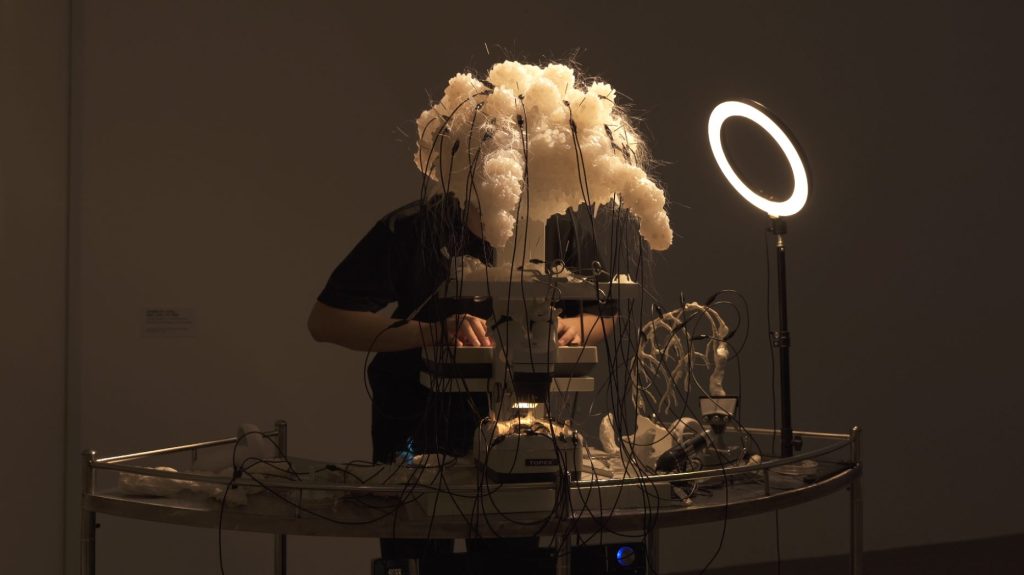
Yoon Jung Won & Dr. Lee Moo Seung, KRIBB // Topic: Microorganisms, insects
The artist Jungwon Yoon has been observing the microscopic world based on his interactions with soil organisms over the past five years. He offers a fresh perspective on contemporary tragedies arising from human attempts to efficiently manage non-human animals for the purpose of economic gains, visibility, and productivity. The Fabricated Containers 03 series, which serves as the latest version of VR Prototype for Soil Organisms, is composed of sculptures examining the two directions of pig slaughter, installations connecting the movements of plants and soil organisms to that of “inflatable advertising dolls with a history of substituting humans,” and an “online dark tour.”
Discussions of “virtual reality,” which represent the omniscience and omnipotence of humans, are completely human-centered at times, and the emphasis of infinite potential actually highlights human finiteness. If a different virtual reality is created, who will create land, and how will we respond when infected with pathogens and viruses? The world as seen through the eyes of a human doll is not that different from virtual reality. This work focuses on contemporary media that rely on the human-scale adaption of non-human scale realms, rather than the expansion and diversification of the human scale. The series is more specific than Fabricated Containers 01 and 02, and hints at the author’s interest in the more complex machine-organism-pet-motion-virtual reality chain. The human alterations created by various mechanisms are fragments of direction methodologies for the “contemporary stage.”
–
Yoon Jungwon – Fabricated Containers 03 Series
Visitor’s Guide and Artist’s Note
1.
Experimental Animals Memorial
2022, Printed on fabric, blind bar, incense burner, ritual dishes, candlestick, 320*120cm, Photo by Yoon Jungwon, Inside the Korea Research Institute of Bioscience and Biotechnology
Upon opening the door, the first piece you encounter, placed in the center, is a photograph of the Experimental Animals Memorial located in the garden next to the laboratory animal facility inside the Korea Research Institute of Bioscience and Biotechnology, printed on a portable blind. Established in 1985 and located in Daedeok Science Town since the 1990s, the Korea Research Institute of Bioscience and Biotechnology(KRIBB), a government-funded research institution, is a place where countless experimental animals like dogs, rats, rabbits, and monkeys are continuously created and killed. From experiments such as injecting pathogens, applying chemicals, and injections, to extracting egg cells for manipulation and inserting and editing human genes to create humanized animals, numerous cruel experiments beyond ordinary expectations and understanding are being conducted. During my research, I learned that some scientists and researchers have been holding memorial services in front of the Experimental Animals Memorial every year since 1994. The memorial’s setup, deeply anthropocentric in nature, including items like animal feed, bananas, and mouse water dispensers on the table, is eerily fascinating. While this memorial may hint at the scientists’ good conscience and guilt, delving deeper into the countless animals buried underneath and their brutal stories raises doubts about the purpose of the memorial’s existence, whether it’s to honor something, to absolve conscience, to cover up incidents, whether the rites are for comforting the animals or themselves. It forces one to contemplate to what extent humans can go ‘for the greater good’ or ‘out of necessity’. It seems many places and hearts in this world where non-human animals meet humans need a memorial. To this end, I transformed the firmly planted memorial stone into a portable form. Yet, this need should eventually disappear. The engraved letters on the rock seem to anticipate long-term use.
2.
Alternative Performers Association
2022, 4 air signs, fabric, ventilators, program switch, employee badge, each 100m100m300cm
In early 2000s Korea, stores celebrating their grand opening invariably featured female laborers, known as ‘narrator models’, dancing in revealing outfits. This seems to be an Asian version of the ‘Sandwich Man’ that appeared in 19th century England. While jobs that attract attention through women’s bodies and choreography still exist, the ‘dancing woman’, once considered a staple of grand openings, has disappeared along with societal perception changes. However, the ‘body’s form remains till the end in the shape of flailing air dancers. We still think of ‘humans’, the ‘narrator models’ we once saw, even when looking at a cross-shaped figure abstracted to the point of suggesting a body, fabric fluttering aimlessly in the wind. This air dancer device operates as a laboring body that can be owned for a nominal electricity fee and is capable of unpaid, repeatable work 24 hours a day. On one side, there’s a museum wanting to own the performance. The contemporary movements of museums and galleries wanting to collect and sell choreography and bodies seem perilous on one hand. They attempt to produce something that operates reminiscent of a past space-time that no longer exists, capable of unpaid, repeatable performance anytime. The scenes I create reveal contradictions arising from replacing non-human animals with humans or humans with non-human animals. Based on the images generated between these three axes, the artist collaborated with an air sign manufacturing company to establish a virtual Alternative Performers Association. What are the interests and perspectives entangled with devices and media referred to as ‘alternative performers’? Those who wish to own movement and bodies, artists with a functional desire to dynamically fill museum spaces, work based on the characteristics that attract the eye to the body, how can we highlight the legitimate discourse of erased humans or non-human animals within these interests? The movements of alternative performers, resembling 3D models on the surface, along with the movements of all other street air signs, pose the question, ‘What is the substitution for?’ How does the body in media operate, and for whom does it move? Going forward, Yoon Jungwon’s exhibition space performances will be outsourced to the Alternative Performers Association.
3.
Slaughter Diorama – For the Museum of Art
2022, Styrofoam, putty, epoxy/ 220100150cm
A scene of a massacre where pigs were culled, buried alive. The sculpture transfers the shape of the pit into a smooth and neat form, referencing characteristics of sculptures often placed in commercial spaces claiming to fuse with art, like OOOOter and OOOck. The display showcases a screen recording of the artist endlessly copying and pasting pig-shaped icons, then dragging & dropping all icons into the trash can when a diseased pig icon appears, a repetitive task.
4.
Slaughter Diorama – For the Museum
2022, Styrofoam, soil, epoxy, resin/ 150cm100cm220cm
Video cooperation: Animal Rights Action KARA, ,
The same form as above. The diorama placed in the museum was created by adopting the production method of dioramas for museums. The display above plays expose videos of the massacre filmed by activists of the Animal Rights Group KARA. (Warning: May induce trauma and contains many brutal scenes. Individual guidance is provided for viewing.)
‘Culling’ is one of the most horrifying events I encountered during my research. Pigs densely bred in factory farms, genetically similar due to repetitive production in the same place, are vulnerable to diseases. In case of an infection with diseases like Foot-and-Mouth Disease or AI, the government orders the death of all pigs, chickens, and cows within a 3km radius of the affected area. Ignoring all guidelines for cheap, quick execution within a short timeframe, thousands are forced into a giant pit, too close to the surface for soil to cover, and buried alive.
5.
Virtual Reality for Soil Organisms – Exhibition Hall, Stage, and Laboratory
2022, Surgery table, hardware, silicone, clay, HMD, computer, and other mixed materials / 250150150cm / Collaboration, Technology: Artist Kim Do-hun / Music: Bukcheong Saja Noreum lamentation, Sword Dance music, Lion Dance music, performance by Dongsunbon and others
6.
37°36’26.9″N 127°03’26.4″E
2021-2022, Specimen box, glass, LCD display, dead insects and molts / 30cm * 40cm* 10cm
Specimens such as shield bugs, moth flies, Korean funnel-web spiders, ghost spiders, and presumed evening moths, among others. All corpses and molts, fungi inside the specimen box were kept from creatures that entered and died in the artist’s studio from the last year to this year. Yoon Jungwon’s studio, located at the coordinates used as the title, is a space for researching the moral status of post-humans and non-human animals and breeding various organisms from cockroaches to dung beetles, house centipedes, tok-tok, and fungi. Nonetheless, other living beings entering this space end up dead or are left to die. Researching society and various fields, I see the line of death drawn between numerous non-human animals and humans. Some continuously struggle, while others mechanically categorize and kill based on the lines drawn by others or systems. It makes one think about how contradictory and vain the discussions of post-human and anti-anthropocentrism handled by artists are. Organizing the corpses of insects (found dead or killed by me) that entered my studio, I constantly questioned. Are they intruders? Refugees? What status and rights do they have? What attitude am I taking? Perhaps, chasing the ghost of post-humanism only to invoke taxidermy, a highly anthropocentric act of the West, wondering if other contemporary artists are also committing the same error.
7.
Dark Ride – Rendering Studio
2022, Continuous 360′ 3D space, interactive web variable installation
Interview video: Hyun-jung Cho, Hyun-sun Ko, animal rights activists from KARA, Yoon Jungwon
Human media acts as a sleek, smooth, and adorable machine of distortion that can infiltrate anywhere. The greatest power of this machine of distortion lies in the fact that once media has evolved sufficiently, it becomes irrelevant and undetectable whether the actual life forms it was showcasing no longer exist or have completely changed. Moreover, humans are not exempt as subjects of such thoroughly tested and refined media’s rendering. Dark Ride – Rendering Studio shifts scenes discovered through research on the process by which human gaze, and the media designed on that basis, transmits, alters, and ultimately substitutes natural phenomena, life forms, and movements. These scenes are moved to a web-based attraction in the ‘dark ride’ genre, similar to those found in theme parks like Universal Studios. The exhibition navigates through backgrounds of pig rendering sites, rendering of laboratory microbes, rendering of hair removal procedures, and stories about ideologies injected into pigeons, among others. Hidden within these scenes are the icons and images of the forthcoming Fabricated Containers series. The term “Rendering,” actively used across all these scenes, is regarded as a key concept encompassing the reason for existence, process, and outcomes of human-made fabricated containers, viewing it as synonymous with 3D modeling and virtual reality itself, heralded as the next frontier.
The scenes related to pig culling include interview videos from the animal rights action group KARA, witnessing events of chicken culling related to avian influenza.
+
*Research on Exhibition Format: Observatory VR
*note:
- Planned, produced, developed by Yoon Jungwon –
- Collaboration: Korea Research Institute of Bioscience and Biotechnology(KRIBB)
- Sponsored by: Daejeon Cultural and Arts Foundation(DACAF)
- Data provided by: Animal Rights Action KARA, Animal Rights Group CARE
_
Interview: Yoon Jung Won
I’m Jungwon Yoon, an artist who works by mixing diverse genres such as dance, media art, and film.
Reasons for Applying for Artience Daejeon:
I had studied science since childhood, and my dream had been to become a scientist. However, through diverse routes, I came to enter the world of the arts and am active as an artist. So I entertained the hope that I should create collaborative works with scientists someday. Seeing this great program, without hesitation I decided to participate.
Collaborative Process:
I focused on creating works, conducting research in the first year and preparing for the exhibition in the second year. In the first year, I had many conversations with Dr. Moo-Seung Lee of KRIBB. In the second year, I had even deeper dialogues with Dr. Jeong Mee Park as well as Dr. Lee. Meanwhile, diligently creating works in my studio, I was able to conduct research on the relations between non-humans and humans in a very multilayered manner and to carry out a lot of exploration visually as well.
Exhibition of the Results:
The scenes I’ve created reveal contradictions that arise when non-human animals are substituted with humans or humans are substituted with non-human animals. For this, I explore the dynamics. I reveal such structures as my works’ operating methods based on research or connect symbols and bring them into the exhibition hall. As the methodology, I borrow the languages of diverse genres such as dance, film, and plastic arts. I explore how a life form is altered and replaced in the structures of diverse media created by humans and what kinds of profits we make and to what we turn a blind eye here.
On the basis of images generated from animal stalls of various genres that alter and process life forms, I’ve established the hypothetical Alternative Performers’ Society. I address what the interests and perspectives intertwined with devices and media to be called “alternative performers” are; those who seek to possess movements and bodies; artists with functional desires to fill the spaces in art museums dynamically; works relying on bodily characteristics that draw attention; and ways to shed light on the stage of valid discussions of humans or non-human animals erased amid such interests. In the center of the exhibition space, I placed portable blinds printed with images of the cenotaph to experiment animals located in the garden next to the Experiment Building within the KRIBB, which the general public cannot easily access.
Though this cenotaph shows scientists’ sense of guilt and conscience as well, when we delve into the cruel circumstances, we’re led to ponder various things such as what the very existence of this cenotaph is intended to remember and to conceal and what humans are capable of in the name of “great causes.” While this portable cenotaph is necessary for countless places in this world, and countless people’s hearts, I believe such a need must disappear someday. I hope to speak of what’s necessary to the world with the seven works in the <Fabricated containers 03> Series released this time.